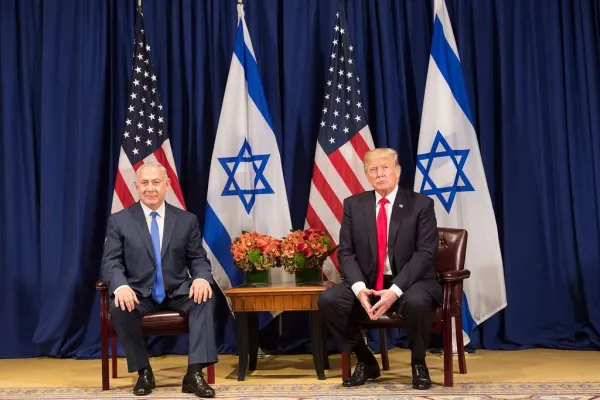
President Donald J. Trump and Prime Minister Benjamin Netanyahu of Israel at the United Nations General Assembly (Official White House Photo by Shealah Craighead) (public domain image)
As the Trump–Netanyahu war against Iran drags into its third week, Americans are still asking the simplest question: why this war at all? What strategic objective justifies it? What national interest demands it? The administration has offered no answer. Instead, the public has been given spectacle.
Washington’s tone has been swagger, not seriousness—stage-managed bravado mixed with sarcasm and theatrical aggression. In a recent interview, Donald Trump boasted that U.S. strikes had “totally demolished” much of Iran’s Kharg Island oil export hub, then added, almost flippantly, that the United States might hit it again “a few more times just for fun.”
This is not responsible statecraft. War is not a reality show, and bombing critical energy infrastructure is not a punchline. Such strikes can destabilize entire regions, rattle global markets, and escalate a conflict whose boundaries are already unclear. Yet the administration presents the campaign less as a strategic necessity than as a performance of dominance.
Meanwhile, Americans are left with fragments, not explanations. Officials speak vaguely of deterrence and regional security but have not explained how bombing Iranian infrastructure advances those goals—or what the endgame is. Regime change? Economic strangulation? Coercive diplomacy? Each scenario carries enormous consequences, yet none has been articulated.
Embedded Policy Influence
The deeper story is Washington’s systematic alignment with Israeli strategic priorities, a bipartisan pattern decades in the making.
Military aid: The U.S. provides Israel with roughly $3.8 billion annually, the largest package in the world. This funding ensures that Israeli priorities—from missile defense to Gaza operations—receive U.S. backing, tying American policy to Israeli military goals.
Congressional votes: Legislators routinely pass resolutions supporting Israeli operations and condemning Palestinian actions, even amid civilian casualties. Committees influenced by pro-Israel lobbying ensure that sanctions, arms sales, and foreign policy legislation mirror Israeli interests.
UN vetoes: The United States has repeatedly blocked Security Council resolutions critical of Israel, shielding it from international accountability while implicitly aligning Washington with Israel’s strategic timeline.
Together, these mechanisms make it plausible that U.S. involvement in regional conflicts—including Iran—is shaped less by American interests and more by Israel’s strategic agenda.
Bipartisan Consensus
Support for Israel spans party lines, but the framing differs: Republicans often justify it through Christian Zionism, while Democrats express political or personal identification with Zionism. In February 2026, U.S. Ambassador to Israel Mike Huckabee told Tucker Carlson that Israel has a biblical right to expand across large parts of the Middle East. Meanwhile, former president Joe Biden has repeatedly described himself as a “Zionist in my heart.”
The Trump administration’s closeness to Netanyahu is unmistakable: since Trump’s second election, Netanyahu has visited the White House seven times, always met with enthusiastic receptions from Republican lawmakers—even after the International Criminal Court issued arrest warrants accusing him of war crimes in Gaza.
This convergence of ideology and politics has created a rare bipartisan consensus in Washington—unquestioning support for Israel—but that unity comes at a cost.
Consequences for U.S. Policy
America’s unqualified backing of Israeli policies—from Gaza to Iran—has done more than erode international legal norms. It has handcuffed U.S. foreign policy, tethering American power to the ambitions of another state, and dragged the country into conflicts that weaken, rather than protect, its long-term security.
As bombs fall and tensions rise across the Middle East, the question is unavoidable: is this war about defending the United States, or is it another conflict fought in service of someone else’s agenda? Where is Congress—the body sworn to safeguard American interests—while the executive branch wades deeper into a foreign war shaped by lobbyists, ideological zeal, and political loyalty? The silence is deafening, and the consequences may be catastrophic.
Until Congress acts and the American public demands accountability, U.S. soldiers will fight, American resources will bleed, and Washington will remain a willing partner in wars that are not its own.
Contact information:
Nader Rahimi
Email: nrahimi@bu.edu